Pages

Sunday, April 10, 2022

Spotlight: Excerpt from A Family Affair by Robyn Carr


Author: Robyn Carr
ISBN: 9780778331742
Publication Date: April 5, 2022
Publisher: MIRA

An exceptional storyteller, #1 New York Times bestselling author Robyn Carr beautifully captures the emotionally charged, complex dynamics that come with being part of any family. Readers will laugh and shed a few tears as they discover what it means to be loved, supported and accepted by the people who mean the most.
 
When a woman notices a young pregant woman attending her husband's funeral she realizes his mid-life crisis went far beyond his weekend warrior lifestyle. But Carr's story of a family dealing with their grief is full of surprises and as everyone examines their own beliefs and behavior, they become closer than they ever thought possible. Carr tackles the serious issues women face with humor and heart.

  
Buy Links: 
 
Here is a sneak peek:


The celebration of life was not held in a funeral parlor or church but rather in a fancy clubhouse in an upscale Mill Valley community. It was furnished with comfortable sofas, chairs, small round accent tables, thick carpet and carefully chosen art. Its primary purpose was for hosting parties. Residents in the community could rent it for events, which Anna had done. There was a huge viewing screen upon which the pictures of Chad’s life played, a hundred and fifty of them, carefully and lovingly chosen by Anna with a little help from the kids. Every picture had Chad in it, starting from old childhood prints she’d inherited from Chad’s mother years ago. She’d glance up to see one of him in a high school football uniform looking the worse for wear with a big grin on his dirty face; she caught a huge blowup of their wedding picture; there was one soon after of him with baby Jessie asleep on his chest. There were many pictures of Chad alone, a few of Chad and Anna, one of a young Anna gazing lovingly up into Chad’s face, several family groupings. The focus was Chad, his life, his accomplishments, his achievements, his happiness, a few of the important people in his life. Chad, Chad, Chad. Just like before he died.

Things had been tense lately, but she remembered those younger years fondly because, although it hadn’t been easy, they had been deeply in love. They met through what can only be described as fate, as destiny. In fact, their meeting was a legendary family story. Anna had been in San Francisco, shopping on her lunch hour down at Fisherman’s Wharf. Shopping but not buying, which was typical for her as she had been and still was very frugal. She loved the sea lions, enjoyed watching tourists, sometimes found bargains at Pier 1, enjoyed the occasional meal on the pier.

On that day, something strange happened. She heard a panicked cry rise from the crowd of tourists on the pier, saw a food truck trundling across the pier without a driver, picking up speed. A man in work clothes and apron was chasing the truck. She only had seconds to take it in. It seemed the food truck, its awning out and moving fast, was headed toward a group of people. Right before her eyes the truck knocked a man off the pier before the truck was stopped by a barricade. 

The man, completely unaware, flew off the dock and into the water below, startling a large number of fat sea lions who had been sunning themselves nearby.

The sea lions scrambled into the water and the man was flailing around in a panic. Someone yelled, “He can’t swim!” Hardly giving it a thought, Anna dropped her purse, kicked off her shoes and jumped off the pier, swimming to the man. Getting to him was no challenge; she practically landed on top of him. But he was hysterical and splashing, kicking and sputtering. “You’re okay, come on,” she said, grabbing his shirt by the collar. But he fought harder and sank, nearly pulling her under with him.

She slapped him in the face and that startled him enough he could let himself be rescued. She slid her arm around his neck and began pulling him to the dock where a couple of men seemed to be standing by to pull him in.

There was a lot of commotion, not to mention honking noises from sea lions. Anna was shivering in her wet clothes and all she could think at the time was how was she going to locate a change of clothes for her afternoon at work. Then there were emergency vehicles and a handsome young police officer draped a blanket around her shoulders and took a report. The near drowning victim was taken away in an ambulance and Anna was given a ride to her apartment by the cute policeman. She was delighted and surprised when the police officer called her a week later. She almost hyperventilated in hope that he’d ask her out.

“The man you pulled out of the water has been in touch. He wants your name,” the officer said.

“He isn’t going to sue me, is he?” she asked.

“I don’t think so,” he said with a laugh. “He seems very grateful. He won’t have any trouble tracking you down but I said I’d ask. He probably wants to thank you.” 

The man’s name was Chad. He was finishing up his PhD at Berkeley while she was working in a law office in the Bay Area. She was twenty-three and he was twenty-seven and she was not prepared for how handsome he was and of course much better put together than when he was dragged out of the water.

He took her to dinner and, as she recalled, their first date was almost like an interview. He wanted to know everything about her and was utterly amazed to learn she’d had a job as a lifeguard in a community pool for exactly one summer when she was a teenager and yet jumped in to save him with total confidence. They fell in love almost instantly. The first time they made love, he asked her to marry him. She didn’t say yes right away, but they knew from the start they were made for each other. What they didn’t know was how many fights they’d have. Very few big fights but many small ones; she thought of them as bickering. They fought about what was on the pizza; a scrape on the side of the car that was not her fault, not even remotely; what kind of vacation they should have and where they should go. As Anna recalled, they always went where Chad wanted to go. They fought about what movie to see, where to eat, what was grumbled under his or her breath.

They fought seriously about his affair. That was in the distant past but it took a long time to get over. Years. But when they finally pledged to stay married, to do their best to make it good, they fell into bed and had the best sex of their lives. And they had Elizabeth.

That experience was how she knew that all the excuses for this current marital rift, no matter what he called it, was probably about another woman and not them growing apart or having divergent needs. He wouldn’t admit it and she had no proof, but she had better than average instincts. She believed he’d gotten all excited at the prospect of falling in love and was rewriting their history to make that acceptable. He was looking for an excuse that would make it reasonable to step outside the bonds of marriage. She could feel it; he’d been involved with someone else.


Excerpted from A Family Affair by Robyn Carr. Copyright © 2022 by Robyn Carr. Published by arrangement with Harlequin Books S.A.


Author Bio: 
 
Photo credit:
Michael Alberstat
Robyn Carr is an award-winning, #1 New York Times bestselling author of more than sixty novels, including highly praised women’s fiction such as Four Friends, The Summer That Made Us and The View from Alameda Island, as well as the critically acclaimed Virgin River, Thunder Point and Sullivan's Crossing series. Virgin River is now a Netflix original series. Robyn lives in Las Vegas, Nevada. You can visit her website at robyncarr.com.

Social Links:
Author Website
Twitter: @RCarrWriter
Facebook: Robyn Carr
Instagram: @robyncarrwriter
Goodreads
 

Saturday, April 9, 2022

Blog Tour: Review & Excerpt from Crimson Summer by Heather Graham


Author: Heather Graham
ISBN: 9780778311829
Publication Date: April 5, 2022
Publisher: MIRA Books
 
Buy Links: 
BookShop.org
Harlequin 
Barnes & Noble
Amazon
Books-A-Million
Powell’s 
 
From New York Times bestselling author Heather Graham, suspense following agents from the FBI and Florida Department of Law Enforcement as they investigate a series of murders linked to conspiracy theorists and doomsday cults.
 
Just when FDLE agent Amy Larson thought she'd wrapped up her most chilling case, she was delivered a red toy horse--a not-so-subtle taunt from a Doomsday cult that she and FBI agent Hunter Forrest hoped they'd taken down. A apparent turf war in Seminole territory in North Florida is the scene of a bloody massacre, and the blame seems to lie with drug cartels out of South America. The trail will take the pair on a cross-country hunt, and deep into a world of conspiracy theories, greed and privilege, where a powerful, hidden group is trying to create civil unrest through violence.

My thoughts:

Crimson Summer picks up pretty much right after the first book, Danger in Numbers, left off.   I would not read this book without reading the first one.  This one absolutely spoils the events and twists in the first book.  This time, Amy and Hunter are after the Red Horse.  The Red Horse seems hell bent on starting wars all over the US.  

I really enjoyed this second book.  As with the first one, I loved the relationship between Amy and Hunter.  It grows stronger even more in this one.  They have great banter and have mutual respect for each other.   The mystery was interesting and a race against time.  I was engaged throughout and couldn't put the book down.  I did call one twist, but the rest were a surprise.  I definitely recommend this one.  


Here is a sneak peek:

Prologue


The sun was out, inching its way up in the sky, casting golden rays and creating a beautiful display of color over the shading mangroves and cypress growing richly in the area. The sunlight touched on the streams running throughout the Everglades, the great “River of Grass” stretching over two hundred acres in southern and central portions of Florida, creating a glittering glow of nature.

The sky was gold and red at the horizon, and brilliantly blue above, with only a few soft puffs of clouds littered about. Diamonds and crystals seemed to float on the water.

Such beauty. Such peace. 

Then there was the crime scene.

The bodies lay strewn and drenched with blood. The rich, natural earth hues of the Everglades were caught in a surreal image, greens and browns spattered liberally with the color red as if an angry child had swung a sopping paint-brush around.

Aidan Cypress had never understood why the mocking-bird had been made Florida’s state bird—not when it seemed that vultures ruled the skies overhead. Never more so than today.

Now, as he stood overlooking the scene with his crew and special agents from the FDLE, trying to control the crime scene against the circling vultures, Aidan couldn’t help but wonder just what had happened and why it had happened this way—and grit his teeth knowing there would be speculation.

Stooping down by the body of a man Aidan believed to be in his midthirties—with dark hair, olive complexion, possibly six feet in height, medium build—he noted the shaft of an arrow protruding from the man’s gut.

All the dead had been killed with arrows, hatchets, axes and knives. Because whoever had done this had apparently tried to make it look like a historical Native American rampage.

Except the killers hadn’t begun to understand there were differences in the weaponry and customs between the nations and tribes of the indigenous peoples across the country.

In South Florida, the dead man’s coloring could mean many things; Aidan himself was a member of the Seminole tribe of Florida, though somewhere in his lineage, some-one had been white—most probably from northern Europe originally. He had a bronze complexion, thick, straight hair that was almost ebony…and green eyes.

South Florida was home to those who had come from Cuba, Central and South America and probably every island out there. The area was truly a giant melting pot. That’s how his family had begun. In a way, history had created the Seminole tribe because there had been a time when settlers had called any indigenous person in Florida a Seminole.

But while the killers had tried to make this look like a massacre of old, the dead men were not Seminole. They were, Aidan believed, Latino. He could see tattoos on the lower arms of a few of the dead who had been wearing T-shirts; a single word was visible in the artwork on the man in front of him—Hermandad.

Spanish for “Brotherhood.”

“What the hell happened here, Aidan?”

Aidan looked up to see that John Schultz—Special Agent John Schultz, Florida Department of Law Enforcement—was standing by his side.

John went on. “It’s like a scene out of an old cowboys and Indians movie!”

Aidan stared at John as he rose, bristling—and yet he knew what it looked like at first glance.

“Quaking aspen,” Aidan said.

“Quaking aspen?” John repeated blankly.

“It’s not native to this area. Look at the arrow. That wasn’t made by any Seminole, Miccosukee or other Florida Native American. That is a western wood.”

“Yeah, well, things travel these days.”

Aidan shook his head. He liked John and respected him. The older agent was experienced, a few years shy of retirement. The tall, gray-haired man had recently suffered a heart attack, had taken the prescribed time off and come back to the field. They’d worked together dozens of times before. He could be abrasive—he had a sometimes-unhappy tendency to say what he thought, before thinking it through.

A few years back John had been partnered with a young woman named Amy Larson. It had taken John a long time to accept her age—and the fact she was female. Once he’d realized her value, though, he’d become her strongest supporter.

But Amy wasn’t here today.

And Aidan missed her. She softened John’s rough edges. 

She was still on holiday somewhere with Hunter Forrest, the FBI agent she’d started dating. They were off on an island enjoying exotic breezes and one another’s company minus all the blood and mayhem.

Aidan stopped lamenting the absence of his favorite FDLE agent and waved away a giant vulture trying to hone in on a nearby body.

Half of the corpses were already missing eyes and bits and pieces of skin and soft tissue.

Aidan sighed and looked around. There were twenty bodies, all of them male, between the ages of twenty and forty, he estimated.

Because he’d noted the tattoos on a few of them, and using his own years of experience, he theorized the dead were members of a gang. Florida had many such gangs. Most were recruits from the various drug cartels, resolved to hold dominion over their territories.

He looked at John, trying to be patient, understanding and professional enough to control his temper. “You know, you may be the special agent, but I’m the forensics expert, and this was not something perpetrated by any of the Florida tribes—or any tribe anywhere. I can guarantee you no one sent out a war party to slaughter some gang members. Someone tried—ridiculously—to make this look like some Natives did this.”

“Hey, sorry, you’re right. Forgive me—just…look around!” John said quickly and sincerely. “It’s just at first sight…well, I mean—wow. You’re right. I’m sorry.”

The apology was earnest. “Okay. Let’s figure out what really happened.”

The corpses were in something of a clearing right by a natural stream making its way through hammocks thick with cypress trees and mangroves and all kinds of underbrush.

While the area was customarily filled with many birds—herons, cranes, falcons, hawks and more—it was the vultures who had staked out a claim. The bodies lay with arrows and axes protruding from their heads, guts or chests, as if they’d fought in a bloody battle. And now they succumbed to decay on the damp and redolent earth.

John followed Aidan’s gaze and winced. “It’s a mess. Okay, well…all right. I’m going to go over and interview the man who found this.”

“Jimmy Osceola,” Aidan said. “He’s been fishing this little area all his life, and he does tours. Two birds with one stone. Members of his family work with him and all of them fish and take tourists out here. He has a great little place right off I-75. It’s called Fresh Catch, and his catch is about as fresh as it gets. Catfish. He’s a good guy, John.”

“I believe you. But we’re going to need a break here—you and your team have to find something for me to go on.”

Aidan stared at him, gloved hands unclenching at his sides. John was rough around the edges and said whatever came to mind, but he was a good cop.

He’d be hell-bent on finding out just what had gone on here.

Aidan told him what he’d heard. “Jimmy was out with a boatload of tourists—they’re right over there. See—two couples, a kid who just started at FIU and two middle-aged women. The first officers on the scene made sure they all stayed. Go talk to them. They look like they came upon a bloodbath—oh, wait, they did.”

John arched a brow to him and said, “Yeah. I got it.”

He headed off to talk to Jimmy Osceola and the group with him.

Aidan studied the crime scene again, as a whole.

First, what the hell had all these men been doing out here? A few of them looked to have been wearing suits; most were in T-shirts and jeans.

The few bodies he had noted—not touching any of them, that was the medical examiner’s purview—seemed to bear that same tattoo. Hermandad.

That meant a gang of enforcers in his mind, and he was sure it was a good guess.

Had a big drug deal been planned?

They were on state land, but it was state land traveled only by the local tribes who knew it. The park service rangers also came through, and the occasional tourist who arranged for a special excursion into the wilds.

Bird-watchers, often enough.

All they’d see today, however, would be the vultures. 

“Aidan.”

He heard his name spoken by a quiet female voice and he swung around.

Amy Larson was not enjoying an exotic island vacation. 

She was standing just feet from him, having carefully avoided stepping on any of the bodies, pools of blood or possible evidence. She was in a navy pantsuit, white cotton shirt and serviceable black sneakers—obviously back to work. 

No matter how all-business her wardrobe, Amy had blue-crystal eyes that displayed empathy and caring. She was great at both assuring witnesses and staring down suspects.

“What are you doing here, Amy?” Aidan asked her. “You’re supposed to be sunbathing somewhere, playing in the surf with Hunter.”

“I was.”

“So what happened?”

“It was great. Champagne, chocolates, sun, surf, sand…” She sighed.

“And?”

“And a little red horse—like the one from last month’s crime scene—delivered right to the room,” she said.


Excerpted from Crimson Summer by Heather Graham, Copyright © 2022 by Heather Graham Pozzessere. Published by arrangement with Harlequin Books S.A.


Author Bio: 
 
Photo Credit:
Marti Corn


New York Times and USA TODAY bestselling author Heather Graham has written more than a hundred novels. She's a winner of the RWA's Lifetime Achievement Award, and the Thriller Writers' Silver Bullet. She is an active member of International Thriller Writers and Mystery Writers of America. For more information, check out her website, TheOriginalHeatherGraham.com, or find Heather on Facebook.
 
Social Links:
Author Website
Twitter: @HeatherGraham
Instagram: @TheOriginalHeatherGraham
Facebook: @HeatherGrahamAuthor
Goodreads
 

Blog Tour: Excerpt from Fool Me Once by Ashley Winstead


Author: Ashley Winstead
ISBN: 9781525899744
Publication Date: April 5, 2022
Publisher: Graydon House Books

 
Buy Links: 
BookShop.org
Harlequin 
Barnes & Noble
Amazon
Books-A-Million
Powell’s 
 
Lee Stone is a twenty-first-century woman: she kicks butt at her job as a communications director at a women-run electric car company (that’s better than Tesla, thank you) and after work she is “Stoner,” drinking guys under the table and never letting any of them get too comfortable in her bed…
 
That’s because Lee’s learned one big lesson: never trust men. Four major heartbreaks set her straight, from her father cheating on her mom all the way to Ben Laderman in grad school—who wasn’t actually cheating, but she could have sworn he was, so she reciprocated in kind.
 
Then Ben shows up five years later, working as a policy expert for the most liberal governor in Texas history, just as Lee is trying to get a clean energy bill rolling. Things get complicated—and competitive as Lee and Ben are forced to work together. Tension builds just as old sparks reignite, fanning the flames for a romantic dustup the size of Texas.

Enjoy this Excerpt:


Chapter 3


Grace under Fire


The Texas State Capitol has always reminded me of Daedalus’s labyrinth, large and elaborate and winding. It could be because I was studying Greek myths the first time I toured it at the tender age of eight, and was also plagued by a truly unfortunate sense of direction. But in my defense, the capitol is made of red granite, an oddly exotic color for a government building—something you  might be more likely to find on, say, the isle of Crete. 

As I grew up, both a feminist and an environmentalist in the staunchly red state of Texas, the idea that the capitol building housed a flesh-eating man with a bull’s head struck me less and less as fictional, and more and more as an apt metaphor.  

But today, there was no doubt Ben Laderman—at this very moment, holed up somewhere inside—was my Minotaur. And for all my wine-induced bravado last night, my hands trembled as we walked up the steps to the capitol. 

The truth was, I’d imagined running into Ben a hundred times since we broke up, picturing exactly how I’d react. There was this one time I’d been sitting with my mom and Alexis in an airport parking shuttle, when a man Ben’s height and coloring lugged his suitcase up the steps. For one dizzying second, thinking it was him, my heart had tried to beat its way out of my chest. Even though the man quickly revealed himself to be a Ben imposter, the buzzing adrenaline hadn’t washed out of my veins until hours later, near the end of our flight. 

How surreal that I was minutes away from actually facing him. 

“The idea for today is to introduce Ben to the bill, since he probably hasn’t had time to review it yet, and secure his buy-in.” Wendy was walking beside me—actually, she was strutting beside me like the steps were a runway. Dakota’s chief of staff was long and lean; everywhere she walked, the world seemed to fold itself into a catwalk just for her. She wore an all-black suit, as sharp and quintessentially no-nonsense as she was. 

“Remember, the most important thing we can walk away with is Ben’s enthusiasm.” She cut a glance at me. “I need charm from you. Is that feasible?” 

“Psshh.” I gave her an affronted look. 

If only Wendy knew the truth about what we were walking into. But there was no way in hell I was going to tell her the project we’d been working on for years, the one with the potential to catapult the company to stardom, could go up in flames thanks to my messy dating life. Somehow, I’d managed to convince everyone at work that I was a talented communications professional, concealing any hint of the Lee Stone that existed outside the hours of nine to five. If Wendy—uptight stickler Wendy—knew what I was really like, I’d be fired before I could count to three. 

Within the monochromatic white walls of Lise, I was Lee, or Ms. Stone to junior employees: a take-no-prisoners messaging maven. Outside of Lise, I was Stoner. And never the twain should meet. 

“Lee’s a pro,” said Dakota, winking from my other side. “She already won over the governor. Besides, this is a good bill. The only reason they wouldn’t go for it is politics.” Dakota said the last word with scorn, and I knew why: she’d been fighting politics her whole life. 

Dakota Young was my hero. She was only ten years older than me, but she’d built Lise from the ground up, thanks to her genius inventor’s brain and business savvy. When I first started as Lise’s comms director, the newspapers had called Dakota “the female Elon Musk”—when they mentioned her at all. My first self-assigned task was to inform them that Dakota had designed and produced her electric vehicle five years before Tesla was a twinkle in Elon’s eye, and the only reason the journalists didn’t know was because our patriarchal society dismissed female inventors. Especially Mexican American female inventors. 

The truth was, Dakota had beat Elon to it and designed a car battery pack with twice the capacity of Tesla’s, meaning our vehicles could go as far as a gas car before needing to recharge. And they took less time to do that, too. There was no reason our cars shouldn’t be the clear winner in the e-vehicle market, but we consistently underperformed. My hypothesis was that it came down to our small profile. 

The disparity in attention between Dakota and Elon had inspired one of my best ideas: changing the name of the company from Unified Electric Vehicles—the yawn-worthy UEV for short—to Lise, pronounced “leez,” in honor of Lise Meitner, a nuclear physicist who’d helped discover nuclear fission, only to be excluded from winning the Nobel Prize for it. The award had gone solely to Otto Hahn, her partner. Her male partner, if I even need to say it. 

I’d gambled on my instincts, telling Dakota we shouldn’t shy away from being known as a female-led tech and auto company, but rather call it out as a strength. She’d gambled on me and agreed; the rest was history. The name change had exploded like a bomb in the press. Dakota was featured in Science, the New York Times, Good Morning America—even Fox News, though that might have been because she’s not only a badass female inventor, but with her long, dark hair and hazel eyes, a gift of her Mexican heritage, she’s a beautiful, badass female inventor. 

Since our rebranding, the whole country had been taken with her, as well they should be. Dakota was the smartest person I’d ever met, managing to toe the line of being a total boss while exuding kindness. She was, to put it mildly, my idol. And also, the older sister I’d never had. My feelings for her were totally healthy. 

I had a good track record at Lise, but passing this bill would seal the deal, establishing that I was a leader. If I was successful, I could ask for a promotion to the position I really wanted: vice president of public affairs.

Ever since reading Silent Spring at the age of ten, I’d grown up obsessed with the fact that we were poisoning our planet, and I’d dreamed of going into politics to do something about it. Being Lise’s comms director was a good position at a great company—nothing a millennial could turn her nose up at—but being in charge of our policy work was what I was really interested in, the goal that got me out of bed each morning. 

And now I was so close. 

Assuming, of course, I didn’t dissolve into a fine mist the minute I set eyes on Ben. 

I turned left toward the meeting room we always used when we came to talk to the governor. It was the biggest room, filled with highly questionable artifacts from Texas history. These artifacts were supposed to paint a picture of Texans as bold, valiant cowboys—framed letters from Mexican presidents pleading to end wars and old-timey weapons in glass cases from the years Texas was “settled” (translation: stolen from indigenous peoples). It was a room that showcased the state’s history without any sense of self-awareness, and being there always put me on edge. Made me question whether we should be working with these people at all, even on something as potentially transformative as the Green Machine bill. 

But Wendy shook her head, tugging my arm. “No Alamo room today. We’re down the hall.” She pointed to the right and I followed her, wondering at the change. 

The three of us halted outside a closed door. Dakota smiled. “Remember, this is bigger than us. We’ve got the health and well-being of the planet on our shoulders. Let’s do this for the people.” 

“No pressure,” I muttered, as Wendy swung open the door.

And there he was, the very first thing I saw. Ben Laderman. Sitting at the right hand of the governor at the conference table. 

Time seemed to freeze as the impact of seeing him in the flesh hit me like a punch to the chest. All the years we’d spent apart were obvious, because he looked different. He wasn’t the Ben from my memories. 

But he was still the easiest person in the world to describe, at least in terms of the basics: Ben Laderman looked exactly like Clark Kent from old comic books. Not Superman, with his perfect, blue-black hair, little forehead curl and confident, square jawline—Clark. 

Don’t get me wrong, Ben had the dark hair and strong jaw and ice-blue eyes, but when I’d known him, he’d kept his hair super short and worn thick-framed black glasses that mostly obscured his eyes. He was well over six feet, but he’d always hunched, like Clark slinking in late to the Daily Planet, trying to creep about unnoticed. 

The Ben Laderman sitting at the table now was…well, there was no way to describe it other than California Ben. He’d grown out his hair and wore it tucked and curling behind his ears. He’d exchanged the thick-framed black glasses for a pair of thin, transparent frames that left no question his eyes were vivid blue. 

And the suit he was sitting ramrod straight in—no more hunch—wasn’t a dark, boxy number like what he’d worn in law school for mock trial. This suit was the same blue as his eyes, a fashion risk that was both startlingly handsome and startlingly playful for someone starting work in the Texas governor’s office. 

He was different. Still knee-wobblingly beautiful, but different.

And he was staring at me.


Excerpted from Fool Me Once by Ashley Winstead, Copyright © 2022 by Ashley Winstead. Published by arrangement with Harlequin Books S.A.


Photo Credit:
Luis Noble
Author Bio: 
 
ASHLEY WINSTEAD is an academic turned novelist with a Ph.D. in contemporary American literature. She lives in Houston with her husband, two cats, and beloved wine fridge.

Thursday, April 7, 2022

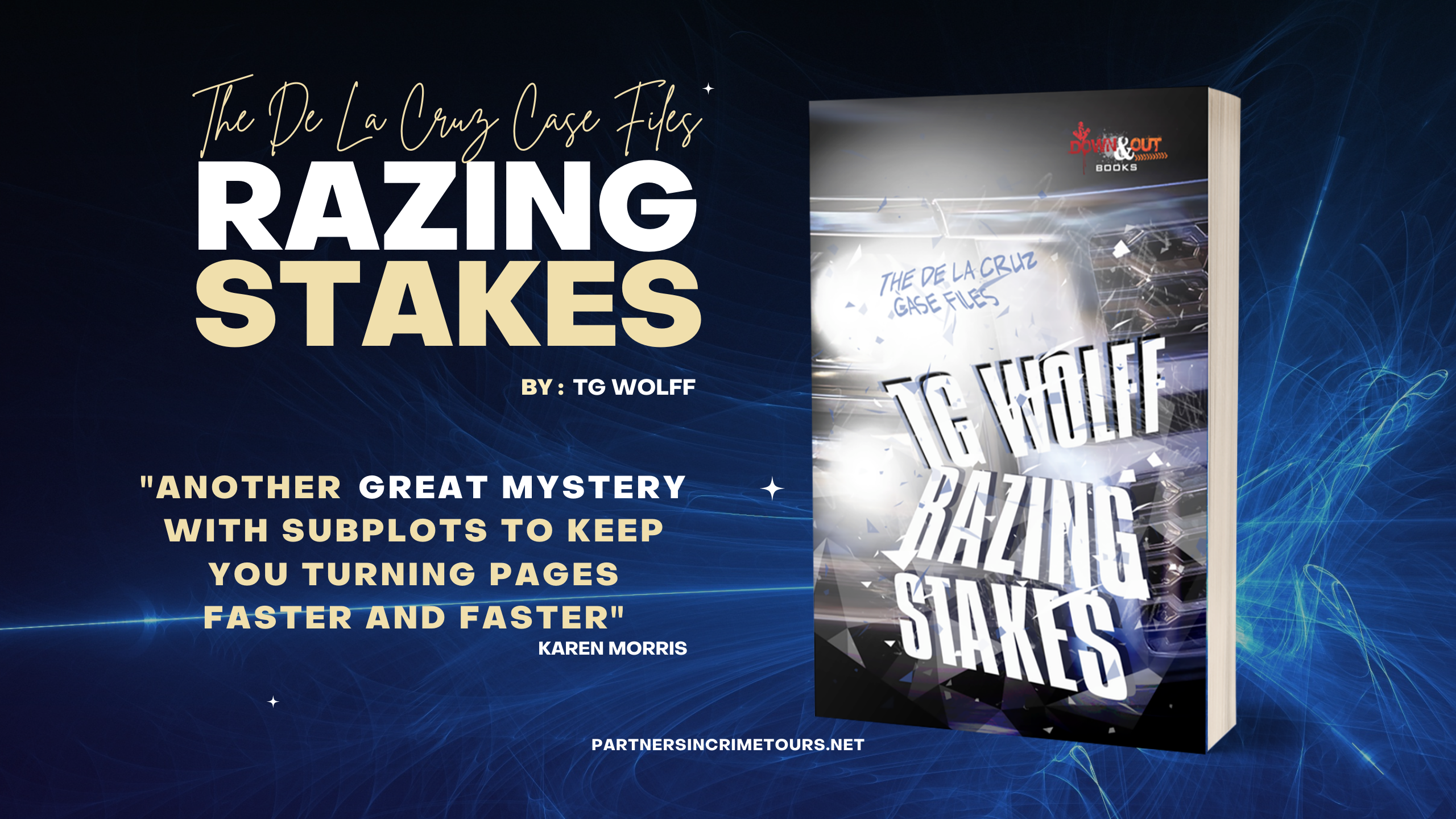
Spotlight: Excerpt from Razing Stakes by TG Wolff


Genre: Mystery
Published by: Down & Out Books
Publication Date: February 14, 2022
Number of Pages: 294
ISBN: 978-1-64396-245-0
Series: The De La Cruz Case Files, 3rd in series
Purchase Links: Amazon | Barnes & Noble | Down & Out Books

The first day of summer is the last day of a young accountant’s life. Colin McHenry is out for his regular run when an SUV crosses into his path, crushing him. Within hours of the hit-skip, Cleveland Homicide Detective Jesus De La Cruz finds the vehicle in the owner’s garage, who’s on vacation three time zones away. The setup is obvious, but not the hand behind it. The suspects read like a list out of a textbook: the jilted fiancée, the jealous coworker, the overlooked subordinate, the dirty client.

His plate already full, Cruz is assigned to a “special project,” a case needing to be solved quickly and quietly. Cleveland Water technicians are the targets of focused attacks. The crimes range from intimidation to assault. The locations swing between the east, west, and south sides of the city. This is definitely madness, but there is a method behind it.

The two cases are different and yet the same. Motives, opportunities, and alibis don’t point in a single direction. In these mysteries, Cruz has to think laterally, yanking down the curtain to expose the master minding the strings.

Read an excerpt:

Ten minutes dead. The sun shined brightly, no clouds on this first day of summer, the last day of John Doe’s life. Cleveland police Detective Jesus De La Cruz squatted next to the broken body. The warmth beneath his hand testified to the newness of death.

Two EMTs had worked to sustain the man’s life. One was at the ambulance now, tending to the tools of his trade. The other stood over the body, shaking his head at the victim. “He was dead before we arrived, Detective. He just didn’t know it.” The EMT peeled off his gloves, finality in a simple act. “Damn it if we didn’t fight for him. In the end, he was just too crushed.”

Cruz rose looking east and west, north and south. The crime scene was on the side of a road halfway between East 9th Street and East 55th Street. North Marginal was a two-way street carved between Lake Erie and a spur off I-90 called the Shoreway. Properties cut off by the Shoreway—the Coast Guard station, Burke Lakefront Airport, a private marina, a condominium complex—were accessed from North Marginal. Even at the busiest times of day, vehicular traffic here was scant. Middle of a workday, a steady stream of runners arced around the first responders.

“Popular place,” Cruz said, meeting the eyes of a curious runner rubbernecking as he slowed to a jog.

“It is,” the EMT said. “Few better places downtown for running. A solid two and a half miles with no cross streets. Whoever hit him came from the east. Blew him up.”

The body spoke for itself. No way it could be where it was being hit from the west. Cruz straddled the curb, which was a generous term for the inch separating the driving surface from the running path. A bicycle wouldn’t call it an obstacle. John Doe either never saw it coming or was unable to get out of the way. The impact had launched him into the airport’s tall security fence. The fence bounced him back, the one-hundred-eighty-pound body a pinball rebounding off bumpers.

John Doe had been moved, necessary and appropriate as he’d been alive when he was found.

“Medical Examiner is en route,” the EMT said. “He’s yours now.”

“I’ll take care of him.” Cruz studied the victim. The man was mostly skin. He had taken off his shirt on the warm day, one of the first to be hot. A shirt lay on the edge of the path, marked by an evidence tag. Two other shirts lay close to the body; one black, one yellow and stained with blood.

The running shorts covered hip to mid-thigh. He wore socks, shoes, and a fitness device on his wrist. Skin was scraped off his arms, legs, chest, and face, the asphalt unforgiving. An AirPod was in his left ear, the right one missing.

Squatting again, Cruz felt the side seams of the shorts, finding zippered pockets. Inside the right one was a slim, card-size piece of plastic, a security badge for a building on East 9th Street. The dead man smiled out of a poor-quality image. Beneath was the name Colin McHenry.

“Detective, we found his phone,” one of the officers securing the scene called out. “It’s in good shape. Thumb print pass coded.”

“Open it before the ME takes him. Who found him?”

“A pair of runners. I parked them under the big tree.” The officer pointed across North Marginal to a small grove on a manmade hill. The two men waited anxiously under the tree, watching the activity. Both were runners. Both were shirtless. Both came to attention as Cruz approached and introduced himself.

“I’m Landon Chartres, this is Denny Bradford. We saw him as soon as we came around the bend. He was half in the street.” The otherwise straight line of North Marginal had a large curve bumping out to make space for an exit from the Shoreway. McHenry’s body would have been screened by the fence and shrubs separating the public from the airport’s private property.

“We knew someone was ahead of us,” Bradford said. “When you turn onto the Marginal, you can you see all the way to the curve.”

Chartres nodded like a bobblehead. “We saw the vehicle that must have hit him. It was the only one that passed us before we got to him. Black SUV. Part of the license plate was LDC. Those are my initials, so it caught my attention. I didn’t catch the make or model.”

Bradford looked behind him, to East 9th Street. He repeatedly shifted his weight from foot to foot. “He was only out of our sight to a few minutes. Would you say he had a five-minute lead, Landon?”

“At most. Probably more like three or four. We called 9-1-1 and pulled him out of the road. Anyone coming around the curve would have hit him. We used our shirts to try to stop the bleeding.”

As a pair of witnesses went, these two were easy, answering questions before he could ask them. They wanted to talk, maybe even needed to talk. “Did anyone pass you from behind, coming from East 9th going east?”

The pair looked at each other, huddled like they were on a pitcher’s mound deciding on a call. It was Chartres who answered. “We don’t think so, Detective, but we couldn’t swear to it. We weren’t paying that much attention. But the one that came toward us, the one with my initials, it was flying.”

“Is he going to make it?” Bradford asked, hope in his voice. “The ambulance got here fast. We kept pressure on his wounds, like they tell you to.”

“I’m sorry, he didn’t.” As if on cue, an engine started. The ambulance pulled away without a passenger.

***

Excerpt from Razing Stakes by TG Wolff. Copyright 2022 by TG Wolff. Reproduced with permission from TG Wolff. All rights reserved.

 Author Bio:

TG Wolff

TG Wolff writes thrillers and mysteries that play within the gray area between good and bad, right and wrong. Cause and effect drive the stories, drawing from 20+ years’ experience in Civil Engineering, where “cause” is more often a symptom of a bigger, more challenging problem. Diverse characters mirror the complexities of real life and real people, balanced with a healthy dose of entertainment. TG Wolff holds a Master’s Degree in Civil Engineering and is a member of Mystery Writers of America and Sisters in Crime.

Catch Up With TG Wolff:
TGWolffCom.wordpress.com
Goodreads
BookBub - @TG_Wolff
Instagram - @tg_wolff
Twitter - @tg_wolff
Facebook


Tour Participants:

Visit these other great hosts on this tour for more great reviews, interviews, guest posts, and giveaways!


ENTER THE GIVEAWAY FOR A CHANCE TO WIN:

This is a giveaway hosted by Partners in Crime Tours for TG Wolff. See the widget for entry terms and conditions. Void where prohibited.


Get More Great Reads at Partners In Crime Tours